星期五, 10月 28, 2005

童年的消逝


雖然本身從事媒體行業,但很少看關於媒體分析的書,可是對於已故媒體分析家Neil Postman的書,卻一直情有獨鐘.Postman很喜歡探討電視文化對社會造成的衝擊,但路數卻很廣泛,把史料、人類學與社會學等學科結合,往往給他扭出新的花樣.「童年的消逝(The Disappearance of Childhood)」正是這樣一部趣味盎然的示範作.

與歷史上大部份概念一樣,童年本身也非想當然的產物,原來有其演變的過程.在更早的年代裏,因為醫療知識與技術的不足,兒童隨時有可能會夭折,再加上成人都已經自顧不暇,因此,童年這個概念是不存在的.那個時代的孩子,一旦脫離襁褓階段,他們的穿著、說話與工作內容,就與成人無異,更沒有何謂「兒童不宜」的概念。那是一個沒有童年的時代。

Postman認為,童年概念的出現,始於印刷術發明之後,因為印刷術使得知識能夠流通,也使得越來越多的人能夠識字,但是這許多識字的人口中,並不包括兒童。因為了解文字的能力,包含了解抽象符號背後的意義,還要有解碼與轉換意義的能力,這些都不是經驗不足的兒童所能操作的,因此,印刷術使得兒童與成人之間的界線變得十分鮮明,童年作為過渡至識字前的狀態因而得到確立。也就是從這個時候開始,兒童的教育、成長、福利問題逐漸成為成人所關切的重要議題。

可是隨著電視的出現,卻導致童年的消逝。因為當書籍是唯一知識管道的來源時,成人可以對資訊加以分門別類,讓孩子在心智成熟之前,過濾一些他不應該、不適宜知道的知識。但是電視的出現,粉碎了成人壟斷知識的權力。因為理解影像遠較辨識符號容易,是孩子在很小的時候便發展完成的能力。因此,在孩子學習閱讀文字之前,電視早已用更強勢的影像語言,教會孩子該知道以及不該知道的事。

也因此在電視出現之後,兒童說話越來越老氣橫秋,像「殘酷一叮」捧紅了舉手投足唱歌談吐學足大人的莫生,對大人的權威越來越不屑一顧,反而成人卻有越來越孩子氣的跡象,童年因此正式消亡。

雖然Postman沒有為如何保存「童年」提供答案,但卻給予讀者一個愉快的閱讀經驗,那種半帶戲謔的筆觸,令人頗有點遊車河般的暢快.補充一句,筆者看的是中譯本,但譯本相當不俗,幾乎沒有翻譯的痕跡.

筆者去年也看過Postman的另一著作「娛樂至死(Amusing ourselves to death)」,同樣串嘴,講即食娛樂文化如何令人活在赫胥黎的美麗新世界(Brave New World)而不自知,有時間再推介.


星期一, 10月 17, 2005

Investment Fables


Apple上周公布業績理想,但股價不升反跌,原因是市場原來的估計更高,這是投資增長股的陷阱之一:如何知道自己的買入價不是反映了過高的增長?著名財經教授Aswath Damodaran的" Investment Fables ",說的就是一段段投資界的迷思.

高息股一定好?
低PE股一定跑贏?
股價低過帳面值是否就是買入訊號?
抑或是盈利穩定、明星公司值得追捧?
相反理論的往績又如何?

諸如此類的十數條問題,是經紀成日掛在口邊的廉價意見,但實情是否一定得,定係好似秋官效應咁,是講講下當真的效應?這本書的目的,就是解釋為何有人覺得這些投資招數掂,實証及最新的財務學研究結果如何,如果真係值得跟,又有乜野要注意的事項.好似市帳率低,是因為隻股平,還是因為其股本回報率低、增長低定係風險大(即股本成本高)?

本書不是一味拆檔那一類,相反它其實認可一些策略,而且會教你如何按圖索驥來揀股.全書只有很少公式,當然有少少底子會較易讀,但作者就每條問題均會把你當門外漢地來說明,故此很易入口,是坊間少有地結合學術及實戰的一本書.

筆者是趁三聯減價時買的,一百四十多塊的hard cover,感覺相當抵,尤其是筆者上次買Damodaran的估值聖經"Investment Valuation"時,花了四百多元呢!

星期一, 10月 10, 2005

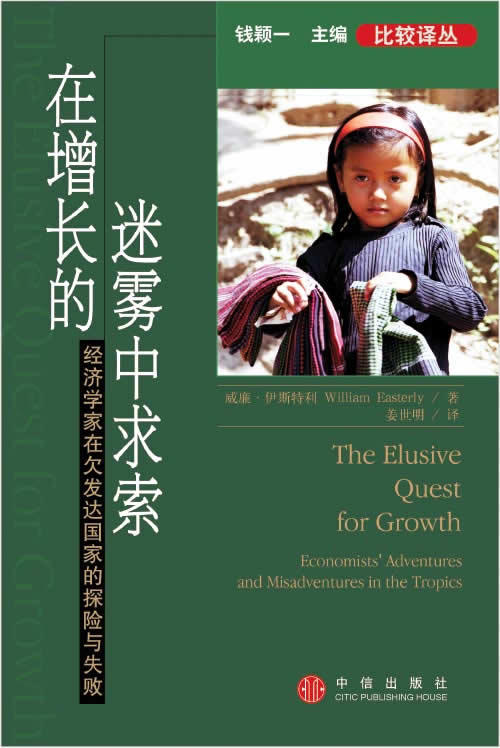
The elusive quest for growth


若果說End of Poverty是一個樂觀經濟學家向貧窮開戰的宣言,那麼”The elusive quest for growth”可說是另一極端,作者William Easterly是紐約大學經濟系教授,曾在世界銀行工作了十多年的時間,他的名氣自然及不上Jeffrey Sachs,但對第三世界貧窮問題及各種藥方效力的了解,卻是不容置疑的.本書在02年初版時,確曾掀起了不少爭論,直到最近”經濟學人”雜誌依舊找其評論這方面的問題.

他在書中引述了不少調查及數據,力陳我們現在所做的一切,包括提供投資援助、改善教育、協助節育、貸款及寬免債務,最後均無補於事.他曾把這些研究向世銀匯報,結果被開除了.

Easterly認為,假若不把對人的激勵放在扶貧措施的核心,只會白花資源,淪為貪官污吏的囊中之物.本書的最大敗筆,就在於沒有為如何就這個誘因機制給出具體建議.

儘管如此,但這本書一樣精闢易讀,一樣多具體例子第一身體驗,只是多了點懷疑及批判,少了點對烏托邦的嚮往,但可能更腳踏實地一點也說不定.總括而言,若看End of Poverty覺得津津有味的話,這本書也不會令你失望.

星期一, 9月 26, 2005

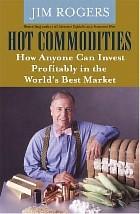
Hot commodities


看到Daisy的首度登場,令人鼓舞.今次介紹的是Jim Roger的Hot Commodities. Jim Roger其人其事不用我多說吧,這本已是04年出版的書,今時今日看更覺仿如隔世.這本恰稱dummies guide to commodities,沒有複雜難明的分析,講的是投資入門,及各種商品的未來供求因素.筆者兩天已了結此書,易入口之餘,卻會感到不夠喉,不過作者有江湖地位加上遠見,確實具備一定的流行元素.

不要以為看後能對寫新聞有很大幫助,但作為入門書也無不可.Roger在書中給出的主要訊息如下:

商品與股市correlation夠低

商品價格可以在經濟差時依然發圍

直接買商品比買商品股要好及簡單


石油、咖啡、糖、铅、黃金 -->掂

今次商品大牛市將歷時10年,但當中會有反覆

若要延伸閱讀,可以看末日博士更早寫成的Tomorrow's Gold,里昂當年幫他出版送給客戶,當時麥嘉華已大聲疾呼要買原材料,不過這本書較為概念性,不少篇幅讓麥嘉華賣弄博學,叫筆者看了好幾十頁奧國學派熊彼德的經濟學說仍未入到正題,結果半途而廢久久未重看,或許日後有機會補看後會覺得值得一書.

星期三, 9月 14, 2005

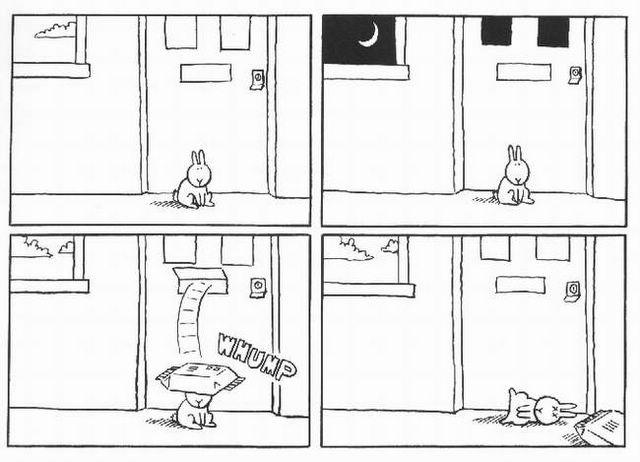
The Book of Bunny Suicides, Return of the Bunny Suicides


香港人成天把「想死、想死」掛在嘴邊,尋死率好似全球第一,不妨把這個話題戲謔一番,也好化解化解怨氣.在網上看到有人介紹這套漫畫書,看了幾頁,已喜歡上了.死,原來也可以很有趣.


星期日, 9月 11, 2005

統計/調查泛濫

近幾年新聞鍾意用很多調查或統計,又話全港有幾多十萬人有呢隻病,又話香港自殺率全球第幾高,又話市民普遍認為要幾多千萬元才夠退休,一直對這些所謂調查抱有懷疑,看了think3介紹的numbers guys專欄,覺得香港為何一直缺少這類肯反省統計泛濫現象的文章,揭破一些有商業或政治企圖,搏宣傳或怪力亂神的統計.

其實即使一些有standing的機構,或大學所作的調查,準確性也大有疑問,傳媒一方面在提供這些資訊作為談資之餘,也是否能容納多些獨立批判的空間?

介紹一段值得一讀的文章,若對統計誤用有興趣,可參看think3早前介紹的書list.

Scientific accuracy

...and statistics
Sep 1st 2005
From The Economist print edition

Just how reliable are scientific papers?

THEODORE STURGEON, an American science-fiction writer, once observed that “95% of everything is crap”. John Ioannidis, a Greek epidemiologist, would not go that far. His benchmark is 50%. But that figure, he thinks, is a fair estimate of the proportion of scientific papers that eventually turn out to be wrong.

Dr Ioannidis, who works at the University of Ioannina, in northern Greece, makes his claim in PLoS Medicine, an online journal published by the Public Library of Science. His thesis that many scientific papers come to false conclusions is not new. Science is a Darwinian process that proceeds as much by refutation as by publication. But until recently no one has tried to quantify the matter.

Dr Ioannidis began by looking at specific studies, in a paper published in the Journal of the American Medical Association in July. He examined 49 research articles printed in widely read medical journals between 1990 and 2003. Each of these articles had been cited by other scientists in their own papers 1,000 times or more. However, 14 of them—almost a third—were later refuted by other work.

Some of the refuted studies looked into whether hormone-replacement therapy was safe for women (it was, then it wasn't), whether vitamin E increased coronary health (it did, then it didn't), and whether stents are more effective than balloon angioplasty for coronary-artery disease (they are, but not nearly as much as was thought).

Having established the reality of his point, he then designed a mathematical model that tried to take into account and quantify sources of error. Again, these are well known in the field.

One is an unsophisticated reliance on “statistical significance”. To qualify as statistically significant a result has, by convention, to have odds longer than one in 20 of being the result of chance. But, as Dr Ioannidis points out, adhering to this standard means that simply examining 20 different hypotheses at random is likely to give you one statistically significant result. In fields where thousands of possibilities have to be examined, such as the search for genes that contribute to a particular disease, many seemingly meaningful results are bound to be wrong just by chance.

Other factors that contribute to false results are small sample sizes, studies that show weak effects (such as a drug which works only on a small number of patients) and poorly designed studies that allow the researchers to fish among their data until they find some kind of effect, regardless of what they started out trying to prove. Researcher bias, due either to clinging tenaciously to a pet theory, or to financial interests, can also skew results.

When Dr Ioannidis ran the numbers through his model, he concluded that even a large, well-designed study with little researcher bias has only an 85% chance of being right. An underpowered, poorly performed drug trial with researcher bias has but a 17% chance of producing true conclusions. Overall, more than half of all published research is probably wrong.

It should be noted that Dr Ioannidis's study suffers from its own particular bias. Important as medical science is, it is not the be-all and end-all of research. The physical sciences, with more certain theoretical foundations and well-defined methods and endpoints, probably do better than medicine. Still, he makes a good point—and one that lay readers of scientific results, including those reported in this newspaper, would do well to bear in mind. Which leaves just one question: is there a less than even chance that Dr Iaonnidis's paper itself is wrong?

星期五, 9月 09, 2005

iPod & Flat World


iPod : "Designed by Apple in California, Made in China."


To be precise, iPod is designed in Cal., it's components are manufactured in Asia, then iPod is assembled in China and is being sold globally.

During my visit to US in March 05, I attended New York Times' columnist Thomas L. Friedman's lecture on his new book -- "The World Is Flat: A Brief History of the Twenty-first Century" (published on 5 April).

He outlined his new book in his lecture, and I chatted with him briefly after the lecture. His book is about "Outsourcing" and "Globalization".

Chatted with audiences and people I met over the trip, I found US public is generally worried about "outsourcing". The lecture was held in Seattle (headquarter of Microsoft and plenty of software companies), hence you can image how middle-class electronic engineers feel when competition pressure from India getting heavier and heavier.

Friedman is an excellent speaker, respond from audience was great. I found the talk interesting too, but I was not as "surprised" and "shocked" as other US audience.

Friedman uses the "The World is Flat" as a metaphor for the fact that "the global playing field is being leveled". The book is about how the convergence of technology and events that allowed India, China, and so many other countries to become part of the global supply chain for services and manufacturing, creating an explosion of wealth in the middle classes of the world's two biggest nations, giving them a huge new stake in the success of globalization.

"Well, what is so new about this ?" I thought.

Perhaps, Hong Kong have located at the very front-line of globalization, we have experienced "outsourcing" for too long. Losing manufacturing jobs to workers in China have been the trend since early 1980's, losing call-center jobs to China have been the trend since early 1990's.

I joined the drink section of a group of audience after the seminar. I found there are plenty mis-conceptions on international trading relationship between US and China. The common mistake is mis-focus on US-China trade deficit figure, and forget the reality is a multi-countries trade & division of labor network.

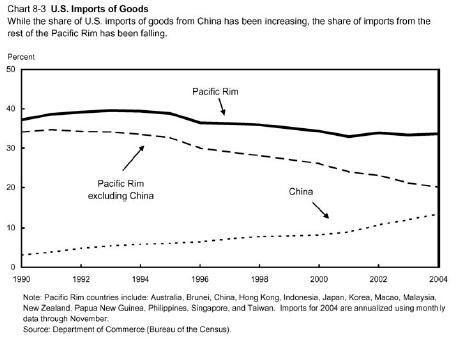
Indeed, there has been a structural change in US-China-Asia trade relationship since mid 90's.

In old days, Asia directly export to US. However, in recent years China emerged as the final assemble centre for Asia's goods (ie. triangular relationship: Asia countries(raw material/technology/components) => china(assemble/manufacture) =>US(sale & marketing).

China becomes the launching-platform of manufacture products. US import from China is mostly a substitution of US import from other Asia (including Japan and Korea) countries (Graphic Source: The Economic Report To President 2005).


Cos, advanced countries like Japan / Korea / US / European have focus on highest - valued components (e.g. design & manufacturing of semi-conductor, DRAM, LCD screen) and shifted the lowest-end manufacturing / final assemble process to their factories in China.

The name-tag "Made In China" has lost its meaning.


In fact, China's semi-finished products and raw material import have been the driver of economic growth in Asia and Latin America. Thankfully, this process (a) bring a lot of employment opportunity to developing countries, (b) pull developed Asian-countries (eg Japan, Korea) out of recession.

Moreover, US multi-national corp (MNC) have extracted huge benefit in the process. US MNC focus on the most high-value added end -- R&D on one end and Sales & Marketing on the other end -- and cut the largest slice of the profit.

For example, US consumer may be surprised by finding their Compac notebook computer is actually assembled in Shanghai, however, this doesn't change the fact that (a) US consumer enjoy the same notebook computer at lower price that otherwise, (b) the notebook is shipped by
Fedex, (c) most of the profit generated from this purchase actually go to Compac / Fedex and their shareholders.

Another example is : when US consumer buy a pair of hottest Nike shoes for $150 (or buy a pair of less fashionable Nike at $35), the factory in China only receive $1.00 per pair of shoe no matter how much the retail price is, and the $149 (or $34) go to Nike's profit, marketing firm, TV, billboard, Micheal Jordon, Walmart / other shoe-chain stores, employees and shareholders in these companies -- who are mainly US citizens. The same pair of Nike shoes also "export" to countries all over the world under the name-tag of "Made in China" and most of the profit go into Nike shareholders' pocket.

A lot of US MNC have seized the opportunity and transformed themselves into the champion of globalization -- Walmart, Nike, Starbuck, Intel, Apple, Compac, Dell, UPS, Fedex
.... etc.

Of course, there are always winner and loser in every new-mega trend – in this case, low-end manufacturing job loss in US and SE Asia countries have lost out. However, no one can reverse the trend and it is not for the benefit of anybody to do so.

Related Article :
日本與中韓台〝技術戰爭〞開打,優勢能撐幾年?


Ipod Nano launching event


If only a press conference can be as funny as this one, our lives would be happier - Ipod Nano launching event - a great product with a great presentation, you are not going to miss it. Here are the link:
http://stream.apple.akadns.net/

星期三, 9月 07, 2005

Watch a clever comedy .....


After a long exhausted day, reading becomes mission impossible. Watch a clever comedy or drama could be the best way to relax before bed.

After chewing up classic comedy “Yes Minister” & “Yes Prime Minister”, I just finished another almost equally sweetly ironic and witty BBC comedy – “Absolute Power - Welcome to the world of public relations”.

Absolute Power originally debuted on BBC Radio 4 in January 2000. Series One: 5 Jan-9 Feb 2000, Series Two: 30 Jan-6 Mar 2001, Series Three: 1 Jan-29 Jan 2003, Series 4: 5 Feb-26 Feb 2004.

Full of smart dialogues, laugh out loud guaranteed.


Absolute Power
UK, BBC, Sitcom, colour, 2002
Starring: Stephen Fry, John Bird, Zoe Telford

Prentiss and McCabe are an unscrupulous pair who run the blue chip PR agency Prentiss McCabe. Dealing with commercial as well as personal PR, their remit covers everything from political communications to celebrity media relations. Their manipulation skills are tested to the full as they frequently find that their work brings them into conflict with political parties, newspaper editors and celebrities.

A satirical comedy about a world in which style triumphs over substance, tabloids are the new judge and jury and where five minutes of fame is considered a long term career.

More than I can read too .....

Books to man is like shoes to woman, we always buy more than we can read and wear.

Having weeks of holiday, hung around bookshop becomes my daily habit. Of course, my books are piling up too quickly. Following are part of my books, and related topics that I have been following. Since I have to focus on my work-related books in coming six months (at least), I can lend my book to friends over the period. See if you guys are interesting in them.

Politic:

  • The New Prince, Dick Morris
  • Feeding The Beast : The White House Versus the Press, Kenneth T. Walsh
  • The White House Staff – Inside West Wing and Beyond, Bradley H. Patterson Jr
  • Electing The President 2000 – The Insiders’ View – Election strategy from those who made it., Kathleen Hall Jamieson & Paul Waldman
  • No Place For Amateurs – How Political Consultants Are Reshaping American Democracy, Dennis W. Johnson
  • Polling Matters – Why Leaders Must Listen to Wisdom of the People, Frank Newport
  • The Prime Minister and Cabinet Government, Neil McNaughton


History:

  • Empire – How British Made The Modern World, Niall Ferguson
  • The House of Rothschild – Money’s Prophets 1798-1848, Niall Ferguson
  • The House of Rothschild – The World’s Banker 1849-1998, Niall Ferguson
  • What If? – Robert Cowley (Chinese translated version)
  • 晚清報業史, 陳玉申
  • 北京的莫理循–Translated from “Morrison of Peking” by Cyril Pearl [George Ernest Morrison 在1897年以英國《泰晤士報》駐清記者身份來華, 親身採訪維新運動、義和團、滿清覆亡、民國成立等巨變, 更在1912年起為袁世凱政治願問. “Morrison of Peking”是澳洲作家Cyril Pearl據Morrison的日記及書信編寫, 於1967年出版的傳記. ]
  • 日本近代史, 林明德
  • 日本現代史, 許介鱗

Social Science:

  • The Working Poor – Invisible in America, David K. Shipler
  • Critial Mass – How one thing leads to another, Philip Ball
  • 行為經濟學 – 理論與應用, 復旦大學

Gambling:

  • Gambling Wizards – Conversations with the World’s Greatest Gamblers, Richard W. Munchkin (Chinese translated version)
  • Poker nation – A High-Stakes, Low-Life Adventure into the Heart of a Gambling Country, by Andy Bellin (Chinese translated version)
  • Hold’em Poker, by David Sklansky
  • Small Stakes Hold’em, by David Sklansky
  • Professional Blackjack, by Stanford Wong


PS: Shall we hold a gathering for members to know each other?


WSJ column "The Numbers Guys"

I enjoy reading WSJ column "The Numbers Guys" a lot. The column examines numbers and statistics in the news, business, politics and health. Some numbers are flat-out wrong, misleading or biased. Others are valid and useful, helping us to make informed decisions.

The column is wrote by
Carl Bialik, a former technology reporter for the Online Journal, is a freelance writer living in Brooklyn, N.Y. He has long had an interest in looking at the way numbers are used, and abused, in the news, business and politics. Carl has a degree in mathematics and physics from Yale University.

He published his reading list in WSJ a month ago, I think it is worth to take a look.

Think3 (7-sep-05)

------------------------------------------------------

Carl's Reading List

August 19, 2005 6:56 a.m.

I have enjoyed reading several books recently on the use and misuse of numbers. Joel Best, a University of Delaware sociology professor, has written two books exposing the subtle choices people make when creating statistics, and the big effects these choices can have. Dr. Best followed up "Damned Lies and Statistics" with "More Damned Lies and Statistics." (The titles play off a famous quote attributed to 19th century British prime minister Benjamin Disraeli: "There are three kinds of lies: lies, damned lies, and statistics.")

In "Tainted Truth," Wall Street Journal reporter Cynthia Crossen exposes the interest groups behind sponsored market research, advertising and, more troublingly, academic and scientific studies.

"Innumeracy," by Temple University math professor John Allen Paulos, explains why his title subject -- the equivalent of illiteracy for numbers -- is widespread and dangerous for society. He followed that book with "A Mathematician Reads the Newspaper," a quirky tour of a standard broadsheet that mixes critiques of numerical misuse with other musings.

Jonathan Koomey distills a career's worth of experience as an energy scientist into "Turning Numbers Into Knowledge." Part III is most germane to this column, with tips on assessing others' numbers and graphs -- plus a gem of a two-page chapter reminding readers that "numbers aren't everything."

The Statistical Assessment Service, a non-profit watchdog group, takes a very modern approach. Articles and shorter posts at Stats.org pick apart misuse of numbers by the media, researchers and industry groups.

And the classic in the genre, Darrell Huff's "How to Lie With Statistics," just turned 50 but is still very relevant. Plus, it's a fun read.

上星期又發書瘟,一口氣買了近10本書,唔知幾時才看得完

書債:

帝國的悲哀 by Chalmers Johnson

New Ideas from Dead Economists by Todp Buchholz 中文版

I Think, Therefore I Laugh by John Allen Paulos

Seeing Voices by Oliver Sacks

Uncle Petros and Goldbach's Conjecture by Apostolos Doxiadis

More What If? Eminent Historians Imagine What Might Have Been edited by Robert Cowley

The Unholy War: The Vatican's Role in the Rise of Modern Anti-semitism by David Kertzer

The Anatomy of Buzz by Emanuel Rosen

An Anatomy of Terror by Andrew Sinclair

星期六, 9月 03, 2005

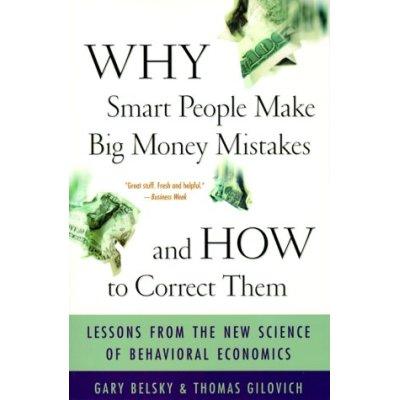
Why Smart People Make Big Money Mistakes And How To Correct Them: Lessons From The New Science Of Behavioral Economics


看了think3介紹的behaviorial finance書,立即想到幾年前看的這本書,一樣無jargon,無公式,只有無數的例子,但就相當便宜,當時我連行為金融學或投資心理學係乜都唔知,可是看這本書就看得津津有味,頗有一開茅塞之感,因為內裡實在有太多過癮的例子,令你保持有追看的衝動,雖然其後閱歷多了,看到了很多例子的出處,但作為一本入門書,這絕對是交足功課有餘.自己其後也看過不少同類書藉,包括cfa的必讀教科書,但心底裡仍然覺得這本最不俗.誠意推薦對這一科目有興趣的人士,又或希望改正自己投資盲點的人.(當然即使筆者我,也常常明知故犯!盲點就是盲點,現實往往就是知易行難)

星期五, 9月 02, 2005

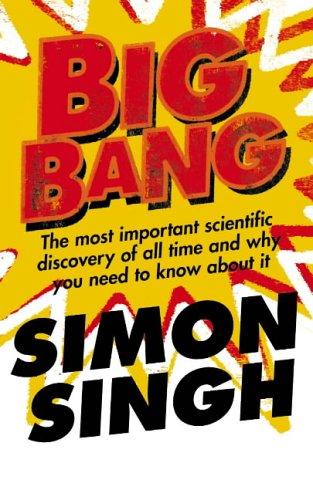
Big Bang


這是Simon Singh的第3部作品,前作Fermat's Last Theorem及Code Book,告訴我原來科普書也可以這樣富娛樂性及影像豐富的.相比之下,今次講宇宙大爆炸理論,前車太多,註定難有驚喜.

結果一如所料,所以讀得特別快,內裡提到的現象如red shift或3K幅射都已是耳熟能詳,可是居然能叫我不跳讀,作者把人事穿插得引人入勝,而且條理清晰到不能再清晰,重點不在於介紹大爆炸這種宇宙論,而是把一場關於宇宙有盡無盡的辯論描繪出來,於是會有Einstein如何押錯邊而慨嘆聰明一世,也有科學家邀功奪名的鬥爭,脈絡是一套理論如何由小眾演變成主流,總之奇兵突出,從聽了不知多少遍的理論中扭出了一點新意來,令這本書依舊有可讀之處.若果對big bang不熟的話,可讀性當必更高.

順帶一提,Singh在附註中提到,這將是其最後一本著作,往後希望有其他新搞作,這對於忠實讀者如我,頗有可惜之感.

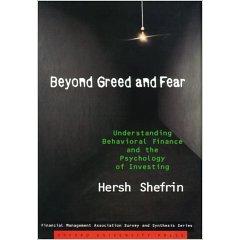
Beyond Greed and Fear: Understanding Behavioral Finance and the Psychology of Investing


Beyond Greed and Fear: Understanding Behavioral Finance and the Psychology of Investing (Hardcover) by Hersh Shefrin

When I worked as Research Assistant under Mr. Edward Kong of EK Investment, I found Edward read a lot of academic journals. I was curious about this and asked him did he find academic research too "theoretical". Edward explained that in investment decision making, knowledge always provide edges. Advance finance research provides new insight on old subject. Although academic research always base on various assumptions that seem unrealistic, however this does not mean we cannot benefit from academic research.

He used efficient market theory as an example. Obviously, the market is not as efficient as the theory suggested, hence, he work backward – If the market is not efficient, what’s wrong with the assumption.

Assumption one of EMT, information is free and equally available, working backward, that’s mean investor with better information can get better results. Assumption two of EMT, given the same information, everyone draws the same conclusion, that means better interpretation and insight on data / event enable investor to earn abnormal results.

In 1996/9, I found Edward spend several days reading a “pillow-like” academic paper. It was research on psychology (yes, psychology, not “psychology on finance” or “behavioral finance”). The book was 1.5 inch thick and full of mathematic formula.

“Well, what the hell! Psychology?” I thought. By that time, I was too busy to learn the basic financial analysis skill. Reading stuff like this was far too advanced for me. But from then on, I have a feeling “psychology” and “finance” have relationship somehow.

At 2000, I found the book: “Beyond Greed and Fear: Understanding Behavioral Finance and the Psychology of Investing” by Hersh Shefrin. Priced at $HK439, but after I finished a chapter, I bought it without any hesitation.

The book explain all kind of psychology research findings that are related to “investing”, “gambling” and “risk taking” such as “Prospect Theory”, “Heuristic-Driven Bias”, “Frame Dependence”, “Representative-ness”, “Anchoring” etc.

Shefrin explain all the key concepts in story-telling style. No mathematic formula, no tons of data, just experiments after experiment, examples after examples.

Almost all the findings were based on psychological experiments under controlled environment. In most of the cases, you can test yourselves with those experiments (in your mind) before he show you the result. A really joyful reading experience, I found.

Over the last 25 years of research, psychologists have discovered two important facts. (1) As psychologist Lola Lopes pointed out, the primary emotions that determine risk-taking behaviour are not greed and fear, but HOPE and FEAR. (2) Although to err is human, financial practitioners of all types make the same mistakes repeatedly.

The cause of these errors is documented in an important collection edited by psychologist Daniel Kahneman (who was the winner of 2002 Nobel Prize in Economics for his work in “Prospect Theory”, despite Kahneman claims to have never taken a single economics course) and other researchers.

The “Beyond Greed and Fear: Understanding Behavioral Finance and the Psychology of Investing” provides a painless way to digest the treasures of 25 years of psychology research on human risk-taking behaviour.


星期四, 9月 01, 2005

Suggestion ...

Glad to gather a group of friends have similar interest. Blog is really a wonderful tool to exchange ideas. We can just get in touch anywhere and anytime.

I had setup several blogs for news-clipping and article-sharing. My experience is when the articles accumulate to certain amount, I found it more convenience to classified information by having several different blogs. This also make it easier to gather friends have different interests.

I suggest we can utilize the existing blog and develope on it. As blog is just a equal platform, every member can post article and opinion. It won't make a different by who is the host. Indeed, it is almost a mission impossible for host to post everything !

Take a look. See if fit. If it is all right, I can invite everybody to be member or even co-host the blog together (blog can be co-manage by members, just do some clicking in setup page) Anyway, I'll station in Guangzhou from 20 sep, so I may not have enough energy to keep it as active as now.

(1) www.midnightoil-society.blogspot.com is for china politic / international affair
(2) www.think-3.blogspot.com is for investment related stuffs
(3) www.damocles-sword.blogspot.com/ is for journalist related stuffs

All the best !

Think3

可以不只介紹書咁簡單

It's amazing to find out that everyone is online at 3:00am!謝謝think3的文章,雖然一口氣拋出兩本書的介紹,但也覺得這裡不應只是介紹書,一些好文章或新思潮,也值得在此分享,希望各位盡用這個園地

Buying and selling volatility


Buying and selling volatility

Author:Kevin B. Connolly

近期窩輪再度成為市場焦點,令我想起一本很久以前看的書,當時剛剛接觸窩輪這新奇事物,可是坊間一直較少淺白易讀的衍生工具書藉,不是叫你一知半解,便是用艱深的數學公式把你包圍,後來碰到這本深入淺出的易「啃」入門書──<買賣波幅>,用門外漢都能懂的語言解答發行人如何賺你錢之謎.

買賣波幅與買賣股價不同之處,在於前者需要不時根據正股變化進行對沖「鎖定」利潤或虧損,亦即動態對沖,因此較單純買賣股票遠為複雜,但本書能做到不用艱深數學模型,而能用淺白語言及圖表,讓人掌握這門概念.同時本書能做到不會野心過大,只集中介紹主要概念,故此不會予人有資料過多消化不良之感.對於一向有投資認股証及期權的投資者,不妨一讀以增功力.

美中不足的是,如何決定一隻股份平貴的理論很多,但究竟如何決定波幅平貴及如何尋找入市機會則鮮有書藉提及,此書也少了這一章,令本書只能停留在理論在層次.建議看完這本書後,可挑戰john hull的Options, Futures and Other Derivatives<--絕對好勁!

The End of Oil


趁住油價新高,中石油批股,不如介紹一本講石油的書.過去因為讀過Daniel Yergin的Prize,所以一直不敢開這本書,擔心又係講石油史,近排有了興頭,翻看一下,居然不賴.作者好似係英國記者,採訪了石油業多年,故此例必有很多訪問及親身經驗.本書涉獵很廣,由hydrogen fuel cell到kyoto protocol到中國如何應對能源危機都包羅,若Prize是以歷史來推進的話,則the end of oil可說是石油業的橫切面,算不上深入,常看economist的可以跳讀,但總算做到不長氣,點到即止,但條理分明,不賣弄文筆.

對於石油的將來,作者是悲觀的,因為美國愛油若癡,而中國又極度飢渴,新能源的開發及投資又似乎步履蹣跚,似乎要一鑊很杰的危機,才能令大家的起心肝,這或許是一場大戰爭.ok, we'll see